You’ve spent thousands on your branding. You’ve sweated over your hero headline. You finally have traffic landing on your site.
But then, the “Bounce” happens.
In less than three seconds, a potential lead decides if you are a legitimate authority or just another fly-by-night operation. Your headline makes the promise, but your Trust Strip proves you can keep it.
What Exactly is a Trust Strip?
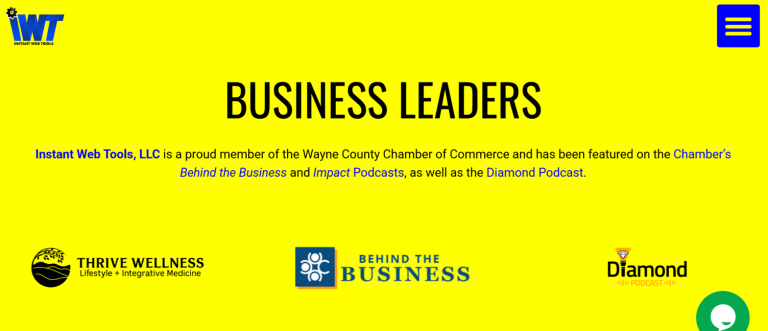
A trust strip (also known as an authority bar or logo wall) is a strategic row of recognizable logos placed directly beneath your hero section. It acts as a visual shorthand for your resume.
Common elements include:
-
Local Authority: Chamber of Commerce, Better Business Bureau (BBB).
-
Media Validation: “As Seen On” logos from news outlets like ABC, FOX, or industry-specific journals.
-
Partnerships: High-profile vendors or software you use (e.g., Microsoft Partner, Google Badge).
-
Social Proof: Podcasts you’ve guest-starred on or awards you’ve won.
The Psychology: Why It Boosts Conversions by 10–30%
Human beings are wired to look for “safety in numbers.” In psychology, this is known as Social Proof and Authority Bias.
-
The Halo Effect: When you place your logo next to the Chamber of Commerce or a major news network, their credibility “rubs off” on you. You aren’t just saying you’re good; they are.
-
Cognitive Ease: Reading a paragraph about your history takes effort. Scanning five logos takes milliseconds. It lowers the “mental friction” required to trust you.
-
The “Safety” Filter: For B2B buyers, the biggest fear is making a bad hiring decision. A trust strip signals that others have already vetted you, reducing their perceived risk.
The Data: According to Stanford Web Credibility Research, 75% of users admit to making judgments about a company’s credibility based on their website’s design. If you lack trust signals, you are fighting an uphill battle from the first click.
The Secret Weapon for Local B2B Companies
For local businesses, a trust strip isn’t just about “fame”—it’s about community roots.
If a local business owner sees the Wayne County Chamber of Commerce logo or a local business podcast badge, it triggers a “one of us” response. It proves:
-
You are an active participant in the local economy.
-
You have a physical presence and a reputation to protect.
-
You are reachable and accountable.
The SEO Bonus: Signals to Search Engines
A trust strip isn’t just for humans; it’s for Google’s crawlers too. Google evaluates websites based on E-E-A-T (Experience, Expertise, Authoritativeness, and Trustworthiness).
When you display logos of organizations that link back to you (backlinks), you create a “Trust Loop.”
-
Validation: You show the logo on your site.
-
Verification: Google sees the high-authority backlink from that organization’s directory or press release.
-
Result: Your Domain Authority (DA) climbs, and your local search rankings improve.
Best Practices for Implementation
To make your trust strip effective, follow these rules:
| Rule | Description |
| Placement | Above the fold. It should be visible immediately after the hero section without the user needing to scroll deep. |
| Color Palette | Use “Greyscale” logos if you want a clean, professional look that doesn’t distract from your CTA button. |
| Linkability | If possible, link the logos to the actual certification or press release to provide “receipts.” |
| Mobile-First | Ensure the logos stack neatly or scroll horizontally on mobile devices. |
Final Thoughts: Don’t Leave Trust to Chance
In a crowded digital marketplace, silence is often interpreted as a lack of experience. If you have the affiliations, the awards, and the memberships, flaunt them. A well-placed trust strip turns a “maybe” into a “yes” by removing the invisible barrier of doubt. Stop asking people to trust you—show them why they already should.